
A current-carrying conductor such as copper wire connected to a 12V battery becomes hot due to the flow of electric current through it. When an electric current flows through a conductor, the charges experience resistance. This resistance to the flow of current causes some of the electrical energy to be converted into heat energy, which increases the temperature of the conductor.
Heating due to collisions
Now, this heating up of a current-carrying conductor can also be explained microscopically.
At the microscopic level, The collisions or interactions that happen between the charges and the atoms heat up the current-carrying conductor. When current flows through a conductor, the electrons are accelerated and drift towards the positive terminal due to the electric field, and on its way it collides with the atoms (positive ions) that make up the conductor. These collisions transfer some of the kinetic energy of electrons to the atoms which in turn cause the atoms to vibrate about their mean position, and the energy from these vibrations is transferred to other atoms and thus the thermal energy is observed, which causes an increase in the temperature of the conductor.

The number of collisions between electrons and atoms is responsible for the thermal energy generated in a conductor. When the current flowing through the conductor increases, the number of collisions between electrons and atoms also increases, leading to a greater transfer of kinetic energy and an increase in the temperature of the conductor. This relationship between the current flowing through the conductor and the temperature of the conductor is described by Joule's Law of Heating.
When electrons feel difficult to move through the conductor due to these collisions, the current goes down across the circuit thus defining resistance. Thus more resistance the electrons encounter more temperature increase is observed. This increase in temperatures will also cause a further increase in the resistance. Thus more electrons flowing, causes ions to vibrate at an increasing rate thus increasing temperature.
In summary, the heating of a current-carrying conductor at the microscopic level is caused by the collisions between electrons and atoms (positive ions), which generate thermal energy and increase the temperature of the conductor. The amount of thermal energy generated and the resulting increase in temperature depending on the magnitude of the current flowing through the conductor and the resistance of the conductor.
Joule's law of heating
The amount of heat generated in a conductor is proportional to the square of the current flowing through it, as well as the resistance of the conductor. This relationship is described by Joule's Law, which states that the heat generated in a conductor is equal to the product of the current squared, the resistance of the conductor, and the time for which the current flows through it.
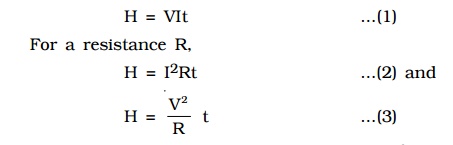
The formula for Joule's Law of Heating is given as:
H = I2Rt
where H is the amount of heat generated in joules (J),
I is the current flowing through the conductor in amperes (A),
R is the resistance of the conductor in ohms (Ω), and
t is the time for which the current flows through the conductor in seconds (s).
Derivation of Joule's Law of Heating
Consider a conductor of resistance R through which a current I is flowing for a time t. The power dissipated by the conductor is given by:
P =VI --------(1)
where V is the voltage across the conductor.
Using Ohm's law, we can express V in terms of I and R as:
V = IR -------(2)
Substituting expression (2) for power, we get:
P = I2R ------(3)
The energy E dissipated by the conductor in time t is given by:
E = Pt (power = energy/time) ------ (4)
Substituting the expression for power, we get:
E = I2RT ------(5)
The energy dissipated by the conductor is equal to the heat generated, so we can write:
H = E
hence,
H = I2RT
This is the formula for Joule's Law of Heating. It shows that the amount of heat generated in a conductor is proportional to the square of the current flowing through it, the resistance of the conductor, and the current flow rate.
Application
A conductor may suffer damage or even completely fail if there is an excessive quantity of current flowing through it, which raises the conductor's temperature above its melting point. Hence it is crucial to check whether the conductor can withstand the amount of current it can carry without overheating.


No comments:
Post a Comment